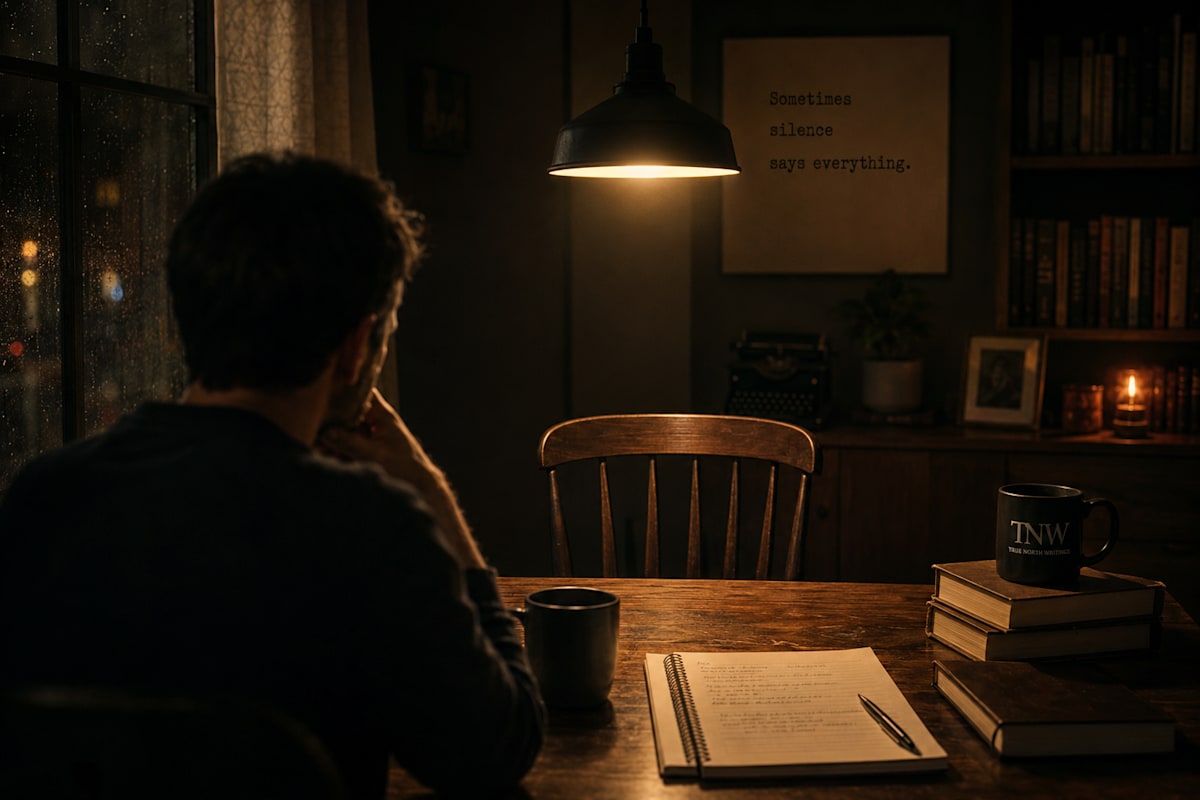
One of my favorite moments in writing happens before anything terrible actually happens.
Nothing has gone wrong yet.
No one has disappeared.
No secret has been exposed.
No relationship has completely fallen apart.
And still, something doesn't feel right.
I love that space.
Because sometimes the most effective tension isn't created by showing the reader the danger.
It's created by letting them feel it coming.
There is a difference between surprising a reader and making a reader uneasy.
I enjoy both.
But uneasiness stays with me longer.
A character walks into a room they've entered a hundred times before, but something is different.
A conversation sounds normal, except one answer comes a little too quickly.
Someone says they're fine.
Maybe they even smile when they say it.
But the reader doesn't believe them.
Neither do I.
That feeling is something I think about constantly when I'm writing psychological fiction.
I don't always want to tell you where the danger is.
Sometimes I don't even want you to know whether there is danger.
I just want you to notice that something has shifted.
Maybe it's a detail that doesn't belong.
Maybe it's something a character should have noticed but didn't.
Maybe it's a question nobody wants to answer.
Or maybe it's something much smaller.
Silence.
A look held a second too long.
A door that should have been locked.
A text message left unanswered.
The wrong person knowing the right piece of information.
None of those things necessarily mean anything by themselves.
That's what makes them interesting.
Because once doubt enters a scene, the reader starts doing something I love.
They start participating.
They begin looking for answers.
Why did he say that?
Why didn't she tell him?
Was that really an accident?
Does this person know more than they're admitting?
And suddenly I'm no longer carrying the entire story by myself.
The reader is investigating it with me.
That's especially important to me because I don't want suspense to depend entirely on twists.
I love a good reveal.
I love reaching the point where one piece of information changes how everything before it is understood.
But a twist means more when the reader has felt its presence long before they understand it.
That's the kind of tension I want to create.
I want you to know something is wrong.
I just don't necessarily want you to know what.
There is also something very human about that feeling.
We've all experienced moments when everything appeared normal but didn't feel normal.
Someone tells you everything is okay.
You believe the words.
You don't believe the person saying them.
You walk away from a conversation and replay it later.
Not because of what was said.
Because of what wasn't.
That's where psychological fiction becomes particularly interesting to me.
The threat doesn't always have to be standing outside the door.
Sometimes it's sitting across the table.
Sometimes it's someone you love.
Sometimes it's the person you've trusted more than anyone else.
And sometimes the most frightening possibility is that the character creating the danger doesn't realize they're doing it.
That last one fascinates me.
Because people don't always understand their own motivations.
We justify things.
We minimize things.
We convince ourselves that we're protecting someone when we're really protecting ourselves.
We call something loyalty because admitting it's obsession would require us to see ourselves differently.
We ignore warning signs because acknowledging them would force us to make a decision we aren't ready to make.
That uncertainty gives me room to write characters who aren't simply heroes or villains.
They're people.
And people can be frighteningly good at believing their own explanations.
That's part of what I explore in Six Minutes Late.
The story deals with obsession, guilt, therapy, attraction, and the increasingly dangerous space between what someone feels and what they're willing to admit.
But I never wanted the psychological tension to exist only in the major moments.
I wanted it in the quieter ones too.
A conversation.
A hesitation.
An attraction someone knows they shouldn't entertain.
A decision that feels insignificant when it's made.
Because sometimes the decision that changes everything doesn't feel important at the time.
That's something I'm carrying into the stories I'm working on now as well.
I've become increasingly interested in what happens when the reader recognizes danger before the character does.
You want to warn them.
You want them to leave.
You want them to ask one more question.
And they don't.
So you keep reading.
Not because you don't know something is wrong.
Because you do.
You just don't know how wrong it is yet.
For me, that's suspense.
Not simply hiding information from the reader.
Giving them just enough information to become suspicious.
Then making them turn the page to find out whether they were right.
And sometimes?
They weren't suspicious enough.
— Henry Daniel Archunde Jr.
True North Writings